
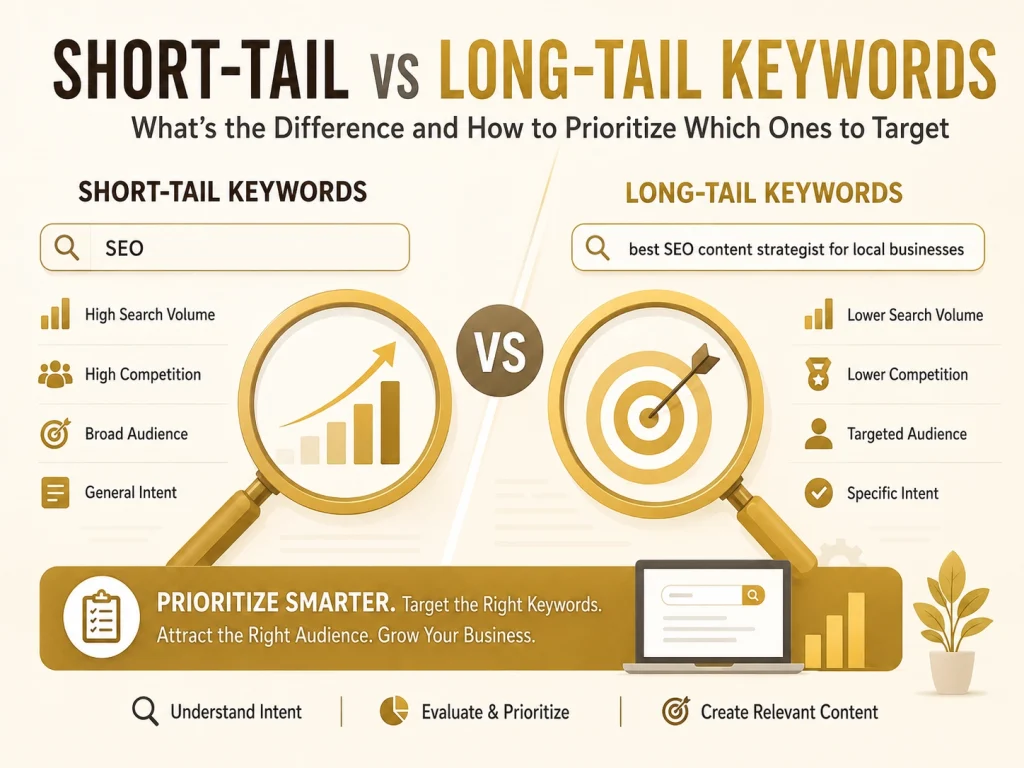
Short-Tail and Long-Tail Keywords: What’s the Difference and Which Should You Target?
Keyword research is one of the most important parts of SEO content strategy. But finding keywords is only the first step. The real value comes from knowing which keywords to target, why they matter, and how they support your website goals.
Two common keyword types you will often hear about are short-tail and long-tail keywords. Both can help your website appear in search results, but they work in different ways.
Short-tail keywords usually have higher search volume, broader meaning, and stronger competition. Long-tail keywords are more specific, often easier to rank for, and usually show clearer user intent.
For a local business, service provider, or growing website, understanding the difference between short-tail and long-tail keywords can help you create smarter content, attract the right audience, and improve your chances of ranking.
What Are Short-Tail Keywords?
Short-tail keywords are broad search terms that usually contain one to three words. They cover general topics and are often searched by many people.
Examples of short-tail keywords include:
- SEO
- keyword research
- content marketing
- local SEO
- digital marketing
These keywords usually have a high search volume because many users search for them. However, they are also more competitive because many websites are trying to rank for the same terms.
For example, the keyword “SEO” is very broad. A person searching for SEO may want a definition, a service provider, a course, a tool, or a complete SEO guide. The intent is not always clear.
Because of this, short-tail keywords can be harder to target, especially for newer websites or local businesses with limited authority.
What Are Long-Tail Keywords?
Long-tail keywords are more specific search phrases. They are usually longer and often contain three or more words. These keywords may have lower search volume, but they often attract users who know exactly what they are looking for.
Examples of long-tail keywords include:
- how to do keyword research for a local business
- best SEO content strategist for small businesses
- short-tail and long-tail keywords difference
- how to prioritize keywords for SEO content
- local SEO content strategy for service businesses
Long-tail keywords are valuable because they show clearer intent. Someone searching for “how to do keyword research for a local business” is likely looking for a detailed guide or professional help related to local SEO.
This makes long-tail keywords easier to match with useful content.
Main Difference Between Short-Tail and Long-Tail Keywords
The main difference between short-tail and long-tail keywords is the level of specificity.
Short-tail keywords are broad. Long-tail keywords are specific.
For example:
| Keyword Type | Example | Search Intent |
| Short-tail keyword | keyword research | Broad informational intent |
| Long-tail keyword | how to do keyword research for local SEO | Specific informational intent |
| Short-tail keyword | SEO content | Broad topic search |
| Long-tail keyword | SEO content strategy for local service businesses | More focused search |
| Short-tail keyword | local SEO | General topic |
| Long-tail keyword | local SEO keyword research process for small businesses | Clearer need |
Short-tail keywords can bring visibility, but long-tail keywords often bring better-qualified traffic.
Why Short-Tail Keywords Matter
Short-tail keywords are still important because they represent major topics in your industry. They help define your website’s main content themes.
For example, if you are an SEO content strategist, short-tail keywords like keyword research, SEO content, and local SEO can guide your main service pages or blog categories.
Short-tail keywords are useful for:
- Building topical authority
- Creating pillar content
- Understanding broad search demand
- Organizing content categories
- Supporting long-term SEO goals
However, short-tail keywords should not always be your first priority, especially if your website is new or competing against bigger brands.
Why Long-Tail Keywords Matter
Long-tail keywords are often more practical for SEO growth. They may not have the highest search volume, but they usually attract people with more specific needs.
For local businesses, long-tail keywords can be especially useful because they help target users who are closer to taking action.
For example, instead of targeting “SEO”, a local SEO content strategist may target:
- SEO content strategist for local businesses
- keyword research process for small business websites
- how to map keywords to the buyer’s journey
- local SEO blog content strategy
- SEO content writing for service pages
These keywords are more specific and often easier to rank for. They also help you create content that answers real questions from your target audience.
Short-Tail vs Long-Tail Keywords: Which Is Better?
Neither keyword type is better in every situation. The right choice depends on your website goals, competition level, audience, and content strategy.
Short-tail keywords are better when you want to build broad topical authority. They are useful for main pages, pillar content, and long-term visibility.
Long-tail keywords are better when you want to attract specific users, answer detailed questions, and rank for less competitive search terms.
A strong SEO strategy usually uses both.
The best approach is to use short-tail keywords as your main topic and long-tail keywords as supporting content ideas.
For example:
Short-tail keyword: keyword research
Supporting long-tail keywords:
- what is keyword research in SEO
- how to do keyword research for local SEO
- how to choose keywords for blog content
- how to map keywords to the buyer’s journey
- short-tail and long-tail keywords difference
This creates a stronger content structure and helps search engines understand your topic coverage.
How to Prioritize Which Keywords to Target
Prioritizing keywords is not just about choosing the terms with the highest search volume. A good SEO content strategy looks at relevance, intent, difficulty, and business value.
Here are the main factors to consider.
1. Start With Search Intent
Search intent means the reason behind a user’s search.
Before targeting a keyword, ask: What does the searcher want?
For example, someone searching “short-tail and long-tail keywords” likely wants to understand the difference between the two. This is an informational keyword, so the best content format is a blog post or guide.
Search intent usually falls into these categories:
| Intent Type | Meaning | Example |
| Informational | The user wants to learn | what are long-tail keywords |
| Navigational | The user wants a specific site or brand | Google Keyword Planner |
| Commercial | The user is comparing options | best SEO content strategist |
| Transactional | The user is ready to take action | hire SEO content writer |
For blog content, informational and commercial keywords are often the best starting points.
2. Check Keyword Relevance
A keyword may have search volume, but that does not always mean it is right for your website.
For example, if your service is an SEO content strategy for local businesses, a keyword like “free keyword tool” may bring traffic, but it may not attract people looking for your services.
A better keyword may be:
- local keyword research process
- SEO content strategy for local businesses
- how to choose keywords for service pages
Relevant keywords help attract visitors who are more likely to engage with your content or become leads.
3. Balance Search Volume and Competition
Many people choose keywords based only on search volume. This can be a mistake.
High-volume keywords are usually more competitive. If many strong websites are targeting the same keyword, it may be difficult to rank quickly.
Long-tail keywords often have lower volume, but they may be easier to rank for and more aligned with user intent.
A practical SEO strategy should include:
- High-volume short-tail keywords for long-term content planning
- Medium-volume keywords for supporting pages
- Low-competition long-tail keywords for faster ranking opportunities
This balance helps you build visibility over time without relying only on difficult keywords.
4. Prioritize Keywords With Clear Business Value
Not every keyword has the same value for your business.
A keyword has strong business value when it attracts people who may need your service, product, or expertise.
For example, these keywords may support business goals:
- SEO content strategist for local businesses
- local SEO content planning
- keyword research for service-based businesses
- SEO blog strategy for small businesses
These keywords are not just about traffic. They connect directly to what a local SEO content strategist offers.
When prioritizing keywords, ask:
- Does this keyword match my service?
- Can I create helpful content around it?
- Will the visitor be part of my target audience?
- Can this keyword support leads, inquiries, or brand authority?
If the answer is yes, the keyword may be worth targeting.
5. Use Short-Tail Keywords for Pillar Pages
Short-tail keywords are ideal for pillar content. A pillar page is a broad, in-depth page that covers a main topic.
For example, if your short-tail keyword is keyword research, your pillar page may explain what keyword research is, why it matters, how it works, and how it supports SEO strategy.
Then, you can create supporting blog posts around long-tail keywords such as:
- how to do keyword research for local SEO
- short-tail and long-tail keywords difference
- how to prioritize keywords for SEO
- how to map keywords to the buyer’s journey
This helps build a connected content structure.
6. Use Long-Tail Keywords for Blog Posts
Long-tail keywords are excellent for blog posts because they usually answer specific questions.
For example, the topic “What is the difference between short-tail and long-tail keywords, and how do you prioritize which ones to target?” is a strong blog topic because it answers a clear informational query.
Long-tail blog content can help you:
- Rank for specific searches
- Answer user questions
- Build topical authority
- Support service pages through internal links
- Attract visitors at different stages of the buyer’s journey
For local businesses, this is especially helpful because blog posts can educate potential customers before they are ready to contact you.
7. Consider the Buyer’s Journey
Keyword priority should also depend on where the searcher is in the buyer’s journey.
The buyer’s journey usually has three main stages:
| Stage | User Mindset | Keyword Example |
| Awareness | The user is learning about a problem | what are long-tail keywords |
| Consideration | The user is comparing solutions | short-tail vs long-tail keywords for SEO |
| Decision | The user is ready to choose help | SEO content strategist for local businesses |
A complete keyword strategy should include keywords for each stage.
Awareness keywords help attract new visitors. Consideration keywords help build trust. Decision keywords help convert visitors into leads.
8. Look for Content Gaps
A content gap is a topic your audience cares about but your website has not covered yet.
For example, if your website already has content about SEO content writing but does not have an article about short-tail and long-tail keywords, this may be a useful content gap.
Content gaps can help you find keyword opportunities that competitors may be using to attract traffic.
To find content gaps, review:
- Your existing blog posts
- Competitor websites
- Frequently asked customer questions
- Search suggestions from Google
- Related searches
- Keyword research tools
Then, choose the topics that are most relevant to your audience and services.
9. Build a Keyword Priority List
Once you have collected keyword ideas, organize them into a simple priority list.
You can use this format:
| Keyword | Type | Intent | Priority | Suggested Content |
| short-tail and long-tail keywords | Long-tail | Informational | High | Blog post |
| keyword research | Short-tail | Informational | Medium | Pillar guide |
| local SEO content strategy | Mid-tail | Commercial | High | Service page |
| SEO content strategist local | Long-tail | Commercial | High | Landing page |
| how to prioritize keywords for SEO | Long-tail | Informational | High | Blog post |
This makes it easier to decide what content to create first.
Recommended Keyword Strategy for Local SEO
For a local SEO content strategist, the best approach is usually to start with long-tail and intent-based keywords before targeting highly competitive short-tail keywords.
A smart strategy may look like this:
- Target long-tail keywords with clear informational intent
- Create blog posts that answer common SEO questions
- Use short-tail keywords as pillar topics
- Link supporting blog posts to important service pages
- Build authority before targeting highly competitive keywords
- Prioritize keywords that connect to local business needs
This approach is more realistic for local websites because it focuses on relevance, clarity, and gradual growth.
Common Mistakes When Choosing Keywords
Many websites struggle with SEO because they target keywords without a clear strategy.
Here are common mistakes to avoid:
- Choosing keywords only because they have high search volume
- Ignoring search intent
- Targeting keywords that are too broad too early
- Writing blog posts without connecting them to service pages
- Using the same keyword on too many pages
- Ignoring local keyword opportunities
- Forgetting to update old content
Keyword research should not be treated as a one-time task. It should guide your content planning, site structure, and long-term SEO strategy.
Need help choosing the right keywords for your website?
A strong SEO content strategy starts with understanding what your audience is searching for and which keywords can support your business goals. If you want to improve your local visibility, attract better traffic, and create content with a clear purpose, working with an SEO content strategist can help you build a more focused keyword plan.
Start with the right keywords, then turn them into content that supports ranking, trust, and conversions.