How Long Does It Take for SEO Content to Rank?
Publishing SEO content is exciting, especially when you have spent time researching keywords, writing the article, and optimizing it for search. But after the content goes live, one question usually comes next: how long does it take for SEO content to rank?
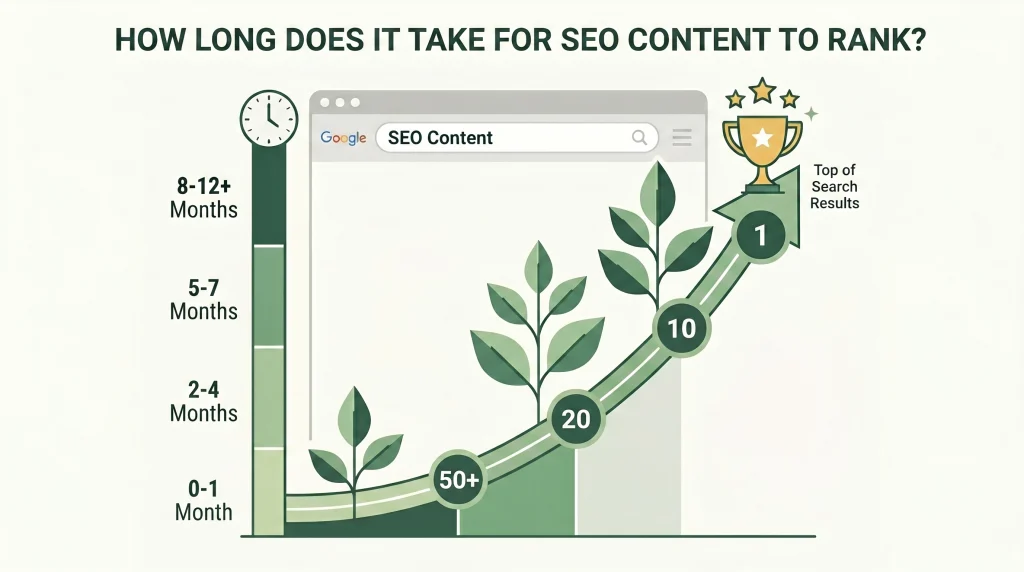
The realistic answer is that SEO content does not rank overnight. Some pages may start showing early movement within a few weeks, but most content needs 3 to 6 months before it gains meaningful ranking progress. For newer websites or highly competitive keywords, it can take 6 to 12 months or longer to see stronger results.
This timeline can feel slow, especially if you are used to paid ads or social media posts that can generate quick visibility. However, SEO works differently. Search engines need time to discover your content, understand its purpose, compare it with existing pages, and decide whether it deserves a higher position in search results.
That is why SEO content should be viewed as a long-term investment. A well-written and properly optimized article may not bring traffic immediately, but once it starts ranking, it can continue attracting visitors for months or even years.
How Long Does SEO Content Take to Rank?
In most cases, SEO content takes 3 to 6 months to show noticeable progress. This does not always mean reaching the first page of Google within that period. It usually means the page begins gaining impressions, appearing for more search terms, and moving gradually through the rankings.
Here is a simple SEO content ranking timeline:
| Timeline | What Usually Happens |
| 1 to 4 weeks | Google discovers, crawls, and may index the page |
| 1 to 3 months | The page may start gaining impressions and early keyword visibility |
| 3 to 6 months | Rankings may improve for long-tail or lower-competition keywords |
| 6 to 12 months | Stronger rankings and more consistent traffic can develop |
| 12 months or more | Competitive keywords may need ongoing optimization, authority, and backlinks |
Some content ranks faster, especially when the keyword has low competition and the website already has authority. Other content takes longer because the topic is competitive, the site is new, or the page needs more support from internal links, backlinks, and updates.
The important thing is to measure progress properly. SEO success is not only about ranking immediately. Early impressions, keyword growth, and improved average position are also signs that the content is moving in the right direction.
Why SEO Content Takes Time to Rank
SEO content takes time because ranking is not a single-step process. When a new article is published, Google needs to go through several stages before the page can appear prominently in search results.
First, search engines need to discover the page. This can happen through your sitemap, internal links, or links from other websites. Once the page is found, Google crawls it to understand the content, structure, headings, and links.
After crawling, the page may be indexed. Indexing means Google has stored the page and made it eligible to appear in search results. However, being indexed does not guarantee high rankings. It only means the page can compete.
The ranking stage is where the real challenge begins. Google compares your content with other pages targeting the same search query. It looks at relevance, quality, usefulness, authority, structure, user experience, and many other signals.
For example, if your article targets a competitive keyword, it may be competing against websites that have stronger domain authority, more backlinks, deeper content, and a longer publishing history. In that situation, even a well-written article may need time and additional optimization before it can move higher.
This is why SEO content should never be judged too quickly. A page that seems quiet during the first few weeks may still gain traction later, especially if it is properly optimized and connected to a broader content strategy.
The Three Stages of SEO Content Ranking
Understanding the ranking process helps set realistic expectations. SEO content usually moves through three important stages: discovery, indexing, and ranking.
1. Discovery
Discovery happens when Google finds your page. If your website has a clean structure and your new article is linked from other relevant pages, search engines can usually find it more easily.
A page with no internal links may take longer to discover because it appears isolated from the rest of the website. That is why every new article should be connected to related pages or posts.
2. Indexing
Once Google discovers a page, it decides whether to index it. Indexed pages can appear in search results, but pages with thin content, duplicate sections, crawl issues, or technical problems may struggle to get indexed.
To support indexing, your content should be original, useful, and easy for search engines to access. Your website should also avoid technical issues such as accidental noindex tags, broken links, or poor mobile usability.
3. Ranking
Ranking is the stage where your page competes for specific keywords. This stage can take the longest because Google evaluates how well your page answers the searcher’s query compared with other available results.
A page can be indexed but still rank on page five, page ten, or lower. Higher rankings usually require strong content, clear search intent alignment, internal links, authority, and ongoing improvement.
What Affects How Quickly SEO Content Ranks?
There is no fixed ranking timeline for every page. Two articles published on the same day can perform very differently. One may gain visibility within weeks, while another may take months to show progress.
The difference usually comes down to several important factors.
1. Website Authority
Website authority plays a major role in how fast content can rank. A new website usually has less trust in Google’s eyes because it has limited publishing history, fewer backlinks, and less topical depth.
An established website, on the other hand, may rank content faster because Google already understands its niche and has seen previous quality signals. If a site consistently publishes helpful content about SEO, marketing, or business growth, new articles on related topics may gain visibility sooner.
This does not mean new websites cannot compete. They can, but they usually need a more focused strategy. Instead of targeting very broad and competitive keywords, new websites should start with specific long-tail topics and build authority over time.
2. Keyword Difficulty
Keyword difficulty is one of the biggest reasons some pages take longer to rank.
Broad keywords are usually harder to rank for because many established websites are already competing for them. A keyword like “SEO” is extremely competitive. A keyword like “how long does it take for SEO content to rank” is more specific and often easier to target.
Long-tail keywords may have lower search volume, but they usually attract visitors with clearer intent. These keywords are especially valuable for newer websites because they offer a more realistic path to visibility.
Instead of chasing only high-volume keywords, a smart SEO strategy balances search volume, competition, and business relevance.
3. Search Intent
Search intent refers to the reason behind a search query. If your content does not match what the user wants, it will struggle to rank even if it includes the right keyword.
For this topic, the searcher likely wants a clear timeline, a simple explanation of why ranking takes time, and practical ways to improve results. They are not looking for a technical lecture or a vague answer.
Strong SEO content should answer the search intent directly. It should give the reader the information they came for while also guiding them toward the next step.
For example, someone searching “how long does it take for SEO content to rank” may also want to know:
- Why their blog post is not ranking yet
- Whether 3 months is enough time to judge SEO results
- What factors affect ranking speed
- How to improve a page that is not performing
- Whether hiring an SEO content specialist can help
When your article covers these related concerns naturally, it becomes more useful and more likely to satisfy the searcher.
4. Content Quality
Content quality is not just about grammar or word count. A long article can still perform poorly if it does not provide value.
Good SEO content should be clear, structured, and genuinely helpful. It should answer the main question early, then expand with useful details, examples, and next steps.
A strong article usually includes:
- A clear introduction
- A direct answer to the main query
- Organized headings
- Natural keyword use
- Helpful explanations
- Practical examples
- Internal linking opportunities
- A strong conclusion
- A clear call to action
Search engines are designed to reward content that helps users. If the article is thin, repetitive, or written only to insert keywords, it is less likely to perform well.
5. Topical Authority
Topical authority means your website has built depth around a specific subject. If your site has several useful pages about SEO content, Google can better understand that your website is relevant to that topic.
For example, one article about SEO content may help, but a full cluster of related articles is stronger. You could support this topic with articles such as:
- What is SEO content writing?
- How to write SEO blog posts
- Why search intent matters in SEO
- SEO content vs regular content
- How to refresh old blog posts
- How to choose keywords for website content
- Why your blog posts are not ranking
These related pages work together. They create a clearer topical map for search engines and a better learning path for readers.
6. Internal Linking
Internal linking is one of the most overlooked ways to help SEO content perform.
When you publish a new article, it should not stand alone. Link to it from relevant pages on your website. You should also link from the new article to other useful pages.
Internal links help search engines discover content, understand relationships between topics, and identify important pages. They also keep readers moving through your site, which can support engagement and conversions.
For example, an article about ranking timelines can naturally link to pages about SEO content writing, keyword research, content strategy, or blog optimization services.
7. Backlinks
Backlinks are links from other websites pointing to your page. They can help build authority and improve rankings, especially for competitive keywords.
However, backlinks should come from relevant and trustworthy sources. A few strong links from reputable websites are better than many low-quality links from unrelated or spammy domains.
Not every page needs backlinks to rank, especially for low-competition keywords. But if you are targeting a competitive topic, backlinks can make a significant difference.
8. Technical SEO
Technical SEO can affect whether search engines can properly crawl, index, and rank your content.
Even the best article may struggle if the website has technical problems. Common issues include slow loading speed, broken links, poor mobile experience, duplicate content, missing metadata, crawl errors, or incorrect indexing settings.
Before expecting SEO content to rank, make sure your website has a healthy technical foundation. A fast, mobile-friendly, and well-structured website gives your content a better chance of performing.
9. Content Updates
SEO content should not be treated as a one-time task. Many articles improve after they are updated.
If a page is not ranking after a few months, it may need stronger headings, more complete answers, better internal links, a clearer title, or additional sections. Updating content based on performance data can help it move higher over time.
Content refreshes are especially useful for pages that already have impressions but low clicks or average rankings on page two or three.
Ranking Timeline for New Websites
For new websites, SEO content usually takes longer to gain traction. A realistic timeline is often 6 to 12 months for steady organic growth.
During the first few months, a new site should focus on building a foundation rather than expecting instant rankings. This includes publishing helpful content, targeting achievable keywords, setting up internal links, improving technical SEO, and creating clear service pages.
New websites should avoid relying only on highly competitive keywords. Instead, they should build momentum with long-tail keywords and niche-specific topics.
Over time, each well-optimized article contributes to the website’s authority. The first few months may feel slow, but consistent publishing can create stronger results later.
Ranking Timeline for Established Websites
Established websites may see faster movement because they already have authority, indexed pages, and existing traffic.
A new article on an established site may begin gaining visibility within a few weeks and show clearer progress within 1 to 3 months. However, this still depends on the keyword and competition.
For established websites, the best opportunities often come from improving existing content. Pages that are already ranking on the second or third page of Google may only need better content, stronger internal links, or improved metadata to climb higher.
In many cases, refreshing old content can be faster than publishing new content from scratch.
How to Know If Your SEO Content Is Working
SEO progress is not always measured by traffic alone. A page may be improving even before it receives many clicks.
Google Search Console can help you understand early performance. Look at whether the page is indexed, what keywords it appears for, how many impressions it receives, and whether its average position is improving.
Important signs of progress include:
- The page is indexed
- Impressions are increasing
- More keywords are appearing
- Average position is improving
- Clicks are starting to appear
- The page ranks for long-tail queries
- Users are engaging with the content
If a page has impressions but a low click-through rate, the title and meta description may need improvement. If it ranks but stays low, the content may need more depth or stronger internal links.
Why Some SEO Content Does Not Rank
Some articles never rank well because they were not built with a clear strategy.
Common reasons include targeting keywords that are too competitive, writing content that does not match search intent, publishing thin or generic articles, ignoring internal links, or having technical issues on the site.
Another common mistake is publishing content without checking what already ranks. If the top results are detailed guides and your article is only a short overview, it will be hard to compete.
SEO content needs to earn its position. That means it should be useful, relevant, well-structured, and better aligned with the searcher’s needs than competing pages.
How to Help SEO Content Rank Faster
You cannot guarantee instant rankings, but you can improve your chances by following a stronger process.
Start with keyword research. Choose topics that match your audience, business goals, and website authority. For newer websites, focus on long-tail keywords before going after broad terms.
Next, study search intent. Look at the pages already ranking and identify what users expect from the content. Your article should meet that expectation while offering a clearer and more helpful answer.
Then, write with structure. Use headings properly, keep paragraphs readable, and avoid unnecessary repetition. Your content should guide the reader smoothly from the main answer to supporting details.
After publishing, add internal links. Connect the article to relevant pages so search engines and users can understand where it fits on your site.
Finally, review and update the content. SEO performance often improves through refinement. A page that does not rank in the first month may still become valuable after several updates.
How Long Does It Take for SEO Content to Rank?
SEO content usually takes 3 to 6 months to show meaningful ranking progress. For new websites or competitive keywords, it may take 6 to 12 months or longer. Some pages can rank faster when they target low-competition keywords, match search intent well, and belong to a website with existing authority.
The timeline depends on several factors, including keyword difficulty, website authority, content quality, topical relevance, internal linking, backlinks, technical SEO, and ongoing updates.
The most effective approach is to treat SEO content as a long-term asset. Instead of publishing one article and waiting passively, build a strategy around useful topics, consistent optimization, and performance tracking.
When SEO content is planned properly, written clearly, and improved over time, it can do more than rank. It can bring qualified traffic, build trust with your audience, and support long-term business growth.
Need SEO Content That Is Built to Rank?
Ranking does not happen by accident. Strong SEO content starts with the right keyword strategy, clear search intent, helpful writing, and proper optimization.
If you want content that is written for both search engines and real readers, working with an SEO content specialist can help you create pages that are easier to find, easier to read, and more likely to support your business goals.